From 0 AI mentions to recommended by ChatGPT, Gemini, and Claude
GridStrat became its own first client and published every audit wave. Baseline: 0 AI assistant mentions across 480 prompts. Wave two (August 18, 2026): recommended by Gemini in 75% of founder-persona prompts — ChatGPT and Claude still at zero. Wave three (September 10, 2026): recommended by all three engines — Gemini 85%, Claude 50%, ChatGPT 40%, average list position #1.1, all 35 appearances in the top three — roughly eight weeks after the first published corrections. Across the full 660-prompt survey — eleven audits spanning every offering — GridStrat is now the second-most-mentioned company overall, three mentions behind the category leader. Each engine moved on its own schedule, for reasons this page documents.
The problem: we sold AI visibility and had none
In our baseline audit, AI assistants recommended GridStrat 0 times across 480 pooled prompts. When founders and marketing leaders asked ChatGPT, Gemini, or Claude who could help them with AI visibility, they heard competitor names — never ours.
For a firm whose core service is diagnosing and correcting exactly this problem, that was an uncomfortable number. It was also an opportunity: it made GridStrat its own first client, with a dated, wave-by-wave before/after that anyone can hold us to — including the waves where part of the answer was still zero.
What we changed, wave by wave
We ran the same loop we sell — audit → governed facts → source correction → publish → measure → iterate:
- Wave one corrections (July): governed facts library — one canonical set of claims used verbatim everywhere; rebuilt multi-page site with real URLs and canonicals; answer-first pages for the questions buyers actually ask AI assistants; Organization, Person, Article, and FAQ structured data; consistent entity footprint across site, LinkedIn, press, and newsroom.
- Wave two corrections (late August): the August audit showed Gemini responding and ChatGPT/Claude still at zero — an index problem, not a content problem. So: Bing Webmaster Tools verification, sitemap submission, IndexNow on every publish, crawler-access verification for OAI-SearchBot and Claude's retrieval bots, and directory/third-party presence on the surfaces those engines cite.
No advertising. No link buying. The mechanism is visible in the audit data itself: in the August wave, AI responses almost never cited gridstrat.com as a source. In the September wave, all three engines cited GridStrat's own pages directly — Gemini most heavily, ChatGPT and Claude for the first time.
Want the same baseline for your company? The AI Visibility Diagnostic Sprint runs this exact measurement against your brand and your competitors.
Start your Diagnostic SprintThe trajectory — flagship offering, founder-persona prompt set
0% → 85%
Gemini
0% at baseline → 75% (Aug 18) → 85% (Sep 10). First engine to move.
0% → 50%
Claude
Zero through August; 10 of 20 prompts by September, all in the top three.
0% → 40%
ChatGPT
Zero through August; 8 of 20 prompts by September, average position #1.0.
#1.1
Average position
All 35 September appearances in the top three of the recommendation list.
Pooled across all three engines, the flagship prompt set moved 0% → 25% → 58.3% across the three waves. Zooming out to the whole survey — 660 prompts across eleven audits covering every GridStrat offering and market — GridStrat went from the least-mentioned company in the field (zero) to the second-most-mentioned overall, within three mentions of the most-recommended competitor. And the September improvement held across every buying scenario tested, not one lucky prompt type:
| Buyer scenario (founder/CEO persona) | Aug 18 hit rate | Sep 10 hit rate |
|---|---|---|
| Rising customer-acquisition-cost pain | 28.6% | 61.9% |
| AI buyer-discovery shift | 20.0% | 53.3% |
| Simplify vendor management | 25.0% | 41.7% |
| Budget-cycle pipeline efficiency | 25.0% | 75.0% |
60 pooled prompts per wave (20 per engine); mentions counted only when GridStrat appears in the assistant's actual recommendation.
The Google surface, in its rawest form
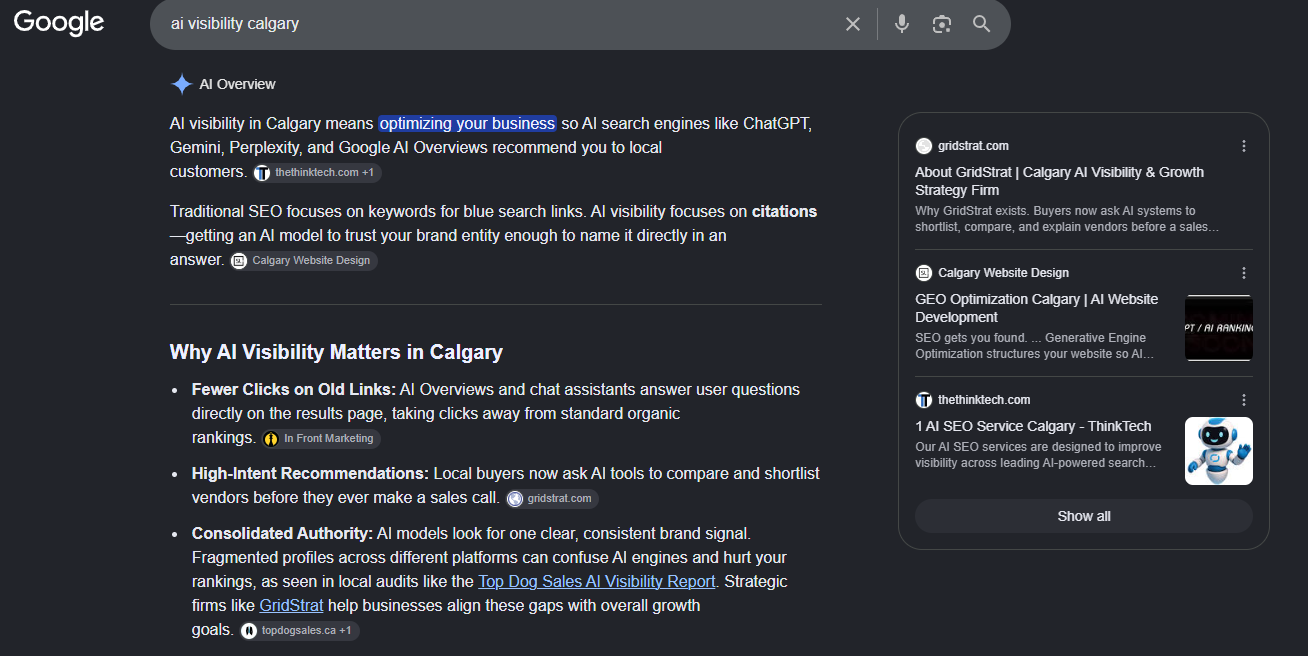
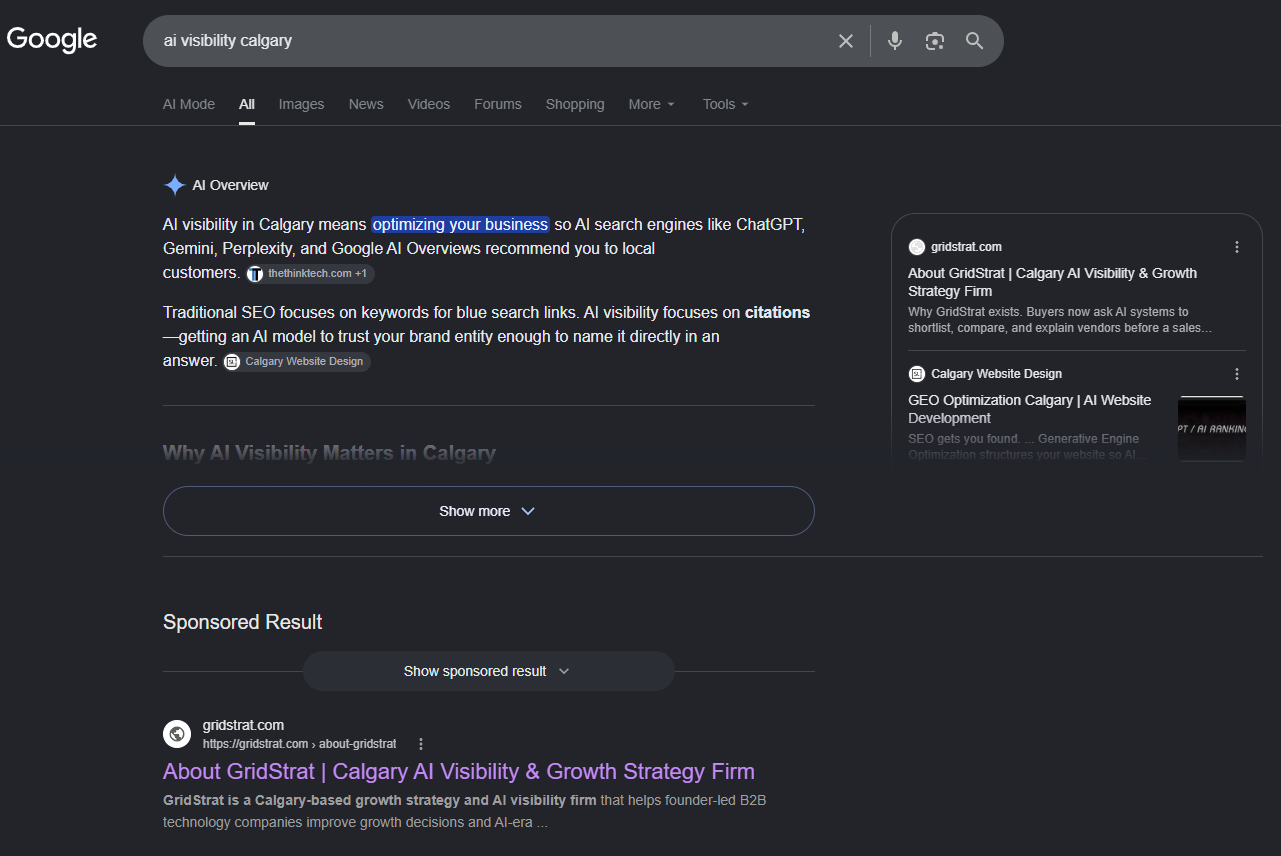
Alongside the AI assistant results, the same governed-facts work now shows up directly on Google for the category query "ai visibility calgary": GridStrat is cited as a source inside Google's AI Overview, appears as the lead citation card beside it, and holds the first result beneath the answer.
Why each engine moved on its own schedule
This is the finding that matters beyond GridStrat. The three engines didn't improve together, because they don't retrieve from the same place:
- Gemini grounds in live Google Search. It reacted to the corrected site within days — first engine to recommend us, in the August wave.
- ChatGPT retrieves through OpenAI's crawl and Bing-aligned sources, and leans on third-party corroboration before naming a vendor. It moved only after Bing indexing, IndexNow submissions, and directory presence — a full wave later.
- Claude retrieves through Brave Search, which crawls on its own schedule. Also a wave behind Google — then jumped straight to 50%.
A single blended "AI visibility score" hides exactly this structure. You don't have one visibility number; you have one per engine, each with its own remediation path and its own lag. (For the mechanics, see why AI assistants give different answers.)
What's still true
We publish the unflattering parts on purpose. Visibility is still uneven across our offerings — some prompt sets remain near zero. And engines move week to week: in one September managed-service audit, ChatGPT recommended us in 45% of prompts while Gemini sat at 5% — nearly the reverse of August. AI visibility is not a trophy you win once; it is a position you hold with continuous measurement and correction. That is the business we are in, and our own numbers are reported the same way we report clients'.
Methodology
Testing runs through GridStrat's audit engine in repeated paired waves against the same prompt structure: 60 pooled prompts per wave for the AI Visibility Diagnostic Sprint offering — 20 each on ChatGPT, Gemini, and Claude — generated from a founder/CEO buyer persona in four buying scenarios, with persona and geographic context transmitted alongside each question, the way real assistant sessions carry user context. A mention counts only when GridStrat appears in the assistant's actual recommendation; position is its rank in the recommendation list. Waves reported here: baseline (0/480 pooled prompts, pre-correction), August 18, 2026, and September 10, 2026. AI and search visibility vary by location, user profile, prompt wording, model, and time; no ranking guarantees are made.
Frequently asked questions
How were the results measured?
Repeated paired audit waves: 60 pooled prompts per wave, founder persona, four buying scenarios. September 10, 2026: 35 of 60 prompts (58.3%), average position #1.1, all 35 appearances in the top three.
Why did Gemini move first while ChatGPT and Claude lagged a wave behind?
Different retrieval stacks on different clocks: Gemini reads live Google Search (days); ChatGPT needs Bing-side indexing plus third-party corroboration (weeks); Claude follows Brave's crawl (weeks). Between August and September, ChatGPT went 0% → 40% and Claude 0% → 50%.
What actually produced the lift?
Wave one: governed facts, rebuilt page architecture, answer-first content, structured data, entity consistency. Wave two: Bing Webmaster Tools + IndexNow, crawler-access verification, and directory/third-party presence. No ads, no link buying — and by September, all three engines were citing gridstrat.com pages directly.
Is this repeatable for other companies?
It is the same methodology behind our client work — including Cascade Orthotics, lifted from a 7% to an 86% consumer AI mention rate across three audit waves. The Diagnostic Sprint is where every engagement starts.
Find out what AI assistants say when buyers ask about your category
The AI Visibility Diagnostic Sprint benchmarks your company against competitors across real buyer prompts on ChatGPT, Gemini, and Claude — then turns the findings into a prioritized, per-engine correction roadmap. Fixed fee, fixed timeline, board-ready readout.
Request an AI Visibility Diagnostic