How PR Influences What AI Tells B2B Buyers About Your Company
Web-connected AI systems assemble answers about your company from a wide information environment — journalism, third-party industry content, comparison pages, reviews, partner sites, research, and press releases — not your website alone. PR helps create the current, verifiable public evidence that shapes how a company is represented during AI-supported research. This article explains what the evidence shows, why the question determines the sources, and a practical 90-day plan to close the gap.
For founder-led B2B technology companies, purchase decisions are no longer shaped only by Google rankings, referrals, and sales conversations. Buyers are increasingly using ChatGPT, Perplexity, Google AI Overviews, and other AI-supported discovery tools to explore categories, compare options, and validate claims.
That changes an important assumption: strong content on your website is still necessary, but it is no longer enough.
Web-connected AI systems assemble answers from a wider information environment that can include company websites, journalism, third-party industry content, comparison pages, reviews, partner sites, research, and press releases. The sources they select depend heavily on the platform and the question being asked.
PR therefore matters as more than a brand-awareness activity. It helps create current, verifiable public evidence that can shape how a company is represented during AI-supported research.
At GridStrat, we see the central question as: What sources are shaping how AI systems represent your company when buyers ask the questions that matter?
The new buying journey: AI first, website second
A founder or VP of Marketing evaluating a software partner may now follow a path like this:
- Ask an AI assistant about the category, available solutions, or vendor differences.
- Review the companies and sources surfaced in the response.
- Validate those signals through search, LinkedIn, third-party coverage, reviews, and company websites.
- Form a shortlist before speaking to sales.
In this process, AI acts like a research assistant. Buyers can form an early view of a company's category relevance, capabilities, and credibility before visiting its website or booking a call.
If the public evidence around your company is sparse, outdated, inconsistent, or poorly aligned with the buyer's question, the resulting answer may be incomplete, generic, or unfavourable. That is the AI visibility gap PR can help address — but PR is only one part of the solution.
Want to know which sources are shaping how AI systems describe your company? Start with GridStrat's AI Visibility Diagnostic Sprint.
Start your Diagnostic SprintWhat the evidence says about PR and AI citations
Muck Rack's May 2026 methodology and findings provide a useful view of the sources cited in web-connected AI responses. Its latest study analyzed more than 25 million citation links across thousands of unbranded, top-of-funnel prompts spanning 17 industries.
The research found that:
- Earned media accounted for 84% of citations.
- Journalism accounted for 27% of cited links.
- Paid and advertorial content accounted for only 0.3%.
- Citation patterns varied significantly by platform, industry, and question type.
These findings show which sources were retrieved and cited in the study. They do not prove that every citation changes a buying decision, that AI systems objectively "trust" every cited source, or that the same pattern applies to every commercial query.
of citations came from earned media
of cited links were journalism
from paid & advertorial content
Source: Muck Rack, "What Is AI Reading?" — May 2026 edition, 25M+ citation links across 17 industries.
Earned media and journalism are related — but not interchangeable
Journalism is independently produced editorial coverage. Earned media is broader and can include journalism, third-party industry articles, partner publications, and other non-owned sources. Press releases are company-controlled materials, even when distributed through a third-party wire.
That distinction matters because different source types play different roles. Credible journalism and respected trade coverage can add independent context. Partner and industry content can establish category relevance. Owned pages can answer detailed product and educational questions directly. Press releases can document timely, verifiable company developments.
The goal is not simply to accumulate mentions. It is to create a consistent body of evidence across the sources most likely to inform your buyers' questions.
The question determines the sources
Muck Rack's analysis found that industry-trend prompts generated more than twice as many journalism citations as how-to prompts. Press releases appeared primarily in industry-trend answers and at 3.5 times the rate seen in "best-of" queries.
For product comparisons, recommendations, and how-to questions, press releases played a much smaller role. Comparison content, reviews, authoritative third-party pages, and strong owned resources may be more important for those queries.
The practical lesson is simple: there is no single content format that wins every AI query. A good visibility strategy begins with the questions buyers ask, then identifies the source types that tend to shape those answers.
Press releases can provide structured evidence
Muck Rack also reported that press-release citations increased fivefold between July 2025 and February 2026. Its press-release guidance emphasizes clear hierarchy, dates, named entities, objective language, supporting links, and specific figures.
This does not mean every release will improve vendor-shortlist visibility. It means a factual, well-structured release can serve as useful source material — especially when it documents a current industry development, partnership, research finding, expansion, or measurable milestone.
Recent information has an advantage — but evergreen authority still matters
More than half of the journalism citations in Muck Rack's research came from content published within the preceding 12 months, with citation rates strongest shortly after publication. Authoritative evergreen resources, however, continued to be cited years after publication when they remained relevant.
This suggests that effective AI visibility programs need both:
- Current coverage and updates that keep the company part of active market conversations.
- Durable, authoritative resources that continue answering important questions over time.
Recency is an observed citation pattern — not proof of a universal AI ranking factor.
What this looks like in a real citation report
The pattern is not just visible in industry studies. Below is a source-citation report from GridStrat Clarity for Cellar Insights, an agricultural storage monitoring company, covering the AI responses for one of its priority product-market vectors — potato storage spoilage detection. Across the tested prompts, 342 unique sources were referenced.
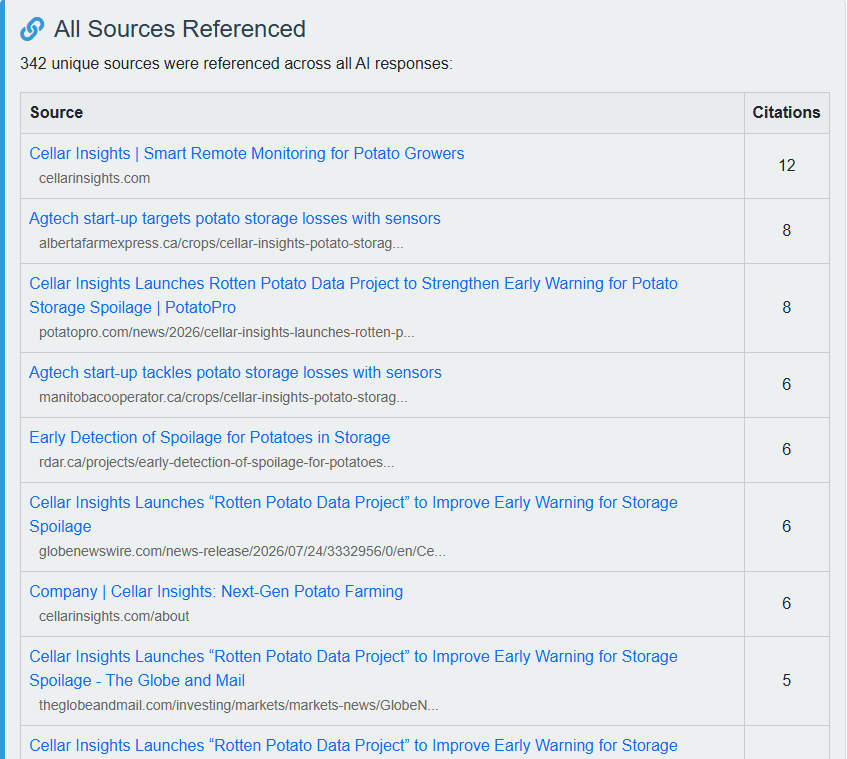
Source: GridStrat Clarity citation report, Cellar Insights potato-storage-spoilage prompt set, August 2026.
The single most-cited source is Cellar Insights' own website. But look at the rest of the top of the table: agricultural trade coverage from Alberta Farm Express, PotatoPro, and the Manitoba Co-operator; a research-partner project page; the company's press release on the wire; and that release's pickup in The Globe and Mail. In aggregate, earned and third-party sources dominate — the same pattern Muck Rack observed at scale, visible in one company's citation data.
This is also a working example of source-mix strategy: owned pages answering directly, trade press adding independent coverage, a research partner adding category credibility, and a structured release syndicating into business media. Each source type is doing a different job in the same answer set.
Why this matters for founder-led B2B technology companies
Founder-led and growth-stage companies are often trying to increase non-paid pipeline without building separate internal PR, SEO, content, and market-intelligence teams. Fragmented execution creates predictable gaps:
- PR operates separately from growth strategy.
- Content is published without a clear visibility thesis.
- SEO performance is measured without examining narrative accuracy or third-party evidence.
- Leadership messaging is not reflected consistently across owned, earned, and partner sources.
- Communications activity is counted, but changes in AI representation are not measured.
AI-supported discovery blends these signals together. Your company narrative, governed facts, media strategy, owned content, partner amplification, and measurement model should therefore reinforce one another.
What good PR looks like in an AI visibility strategy
1. Start with representation, not output
Before producing more content, assess how AI and search systems currently represent your company. Ask:
- Does the company appear for the priority category, comparison, and problem-based prompts?
- How is it described, and which facts or differentiators are missing?
- Which sources are cited, and are they accurate, current, and commercially useful?
- Which competitors appear alongside it — and why?
- Do the results change across platforms, prompts, personas, and locations?
A diagnostic sprint establishes the baseline before production scales.
2. Build from governed facts
Create an approved fact base that covers:
- Company and product descriptions
- Market-category language
- Customer outcomes and proof points
- Leadership biographies and quotes
- Partnerships, integrations, and milestones
- Funding, hiring, and expansion details
- Verifiable statistics and supporting evidence
This reduces drift across press releases, web pages, thought leadership, partner materials, and sales narratives.
3. Turn real business events into citable assets
The strongest PR starts with something objectively true and commercially relevant, such as:
- A meaningful partnership or integration
- Measurable product adoption
- Original research or market findings
- Expansion into a new market
- An executive hire
- Funding activity
- A documented customer outcome
- A security, compliance, or product milestone
Lead with the facts, explain why the development matters, link to supporting evidence, and make the information easy to verify.
Consider a cybersecurity company that launches a significant integration but announces it only on LinkedIn. Its website, partner pages, comparison sites, and trade coverage remain unchanged. Buyers asking AI which platforms support that integration may never encounter the new capability. A coordinated release — supported by an updated integration page, partner confirmation, targeted trade outreach, and subsequent measurement — creates several consistent sources around the same fact.
4. Prioritize the right source mix
A broad wire distribution may help with some timely industry questions, but the right mix depends on the prompts and platforms that matter. It may include:
- Your website, newsroom, product pages, and educational content
- Relevant trade and business publications
- Partner websites and co-marketing channels
- Trusted comparison and review sites
- Original research and expert commentary
- Selective wire distribution for genuine news
The objective is not maximum duplication. It is accurate, consistent reinforcement across credible sources that serve different parts of the buying journey.
Connect intelligence, communications, and measurement
GridStrat's approach connects AI-visibility intelligence with growth strategy and communications execution. Through the GridStrat platform and our senior-led advisory work, we diagnose how companies are represented, identify weak or missing signals, and prioritize the content and third-party validation most likely to improve discovery and buyer confidence.
Our partnership with ExpandCommunication extends that operating model. GridStrat identifies the prompts, narrative gaps, competitors, and sources shaping buyer discovery; ExpandCommunication helps turn commercially relevant developments into credible stories and targeted media opportunities.
Here is what that looks like in practice for the same client. ExpandCommunication's PR & Visibility dashboard tracks the communications program for Cellar Insights — press material, premium coverage, clippings, and the PR calendar; the GridStrat Clarity citation report shown earlier measures how that body of coverage surfaces in AI responses.
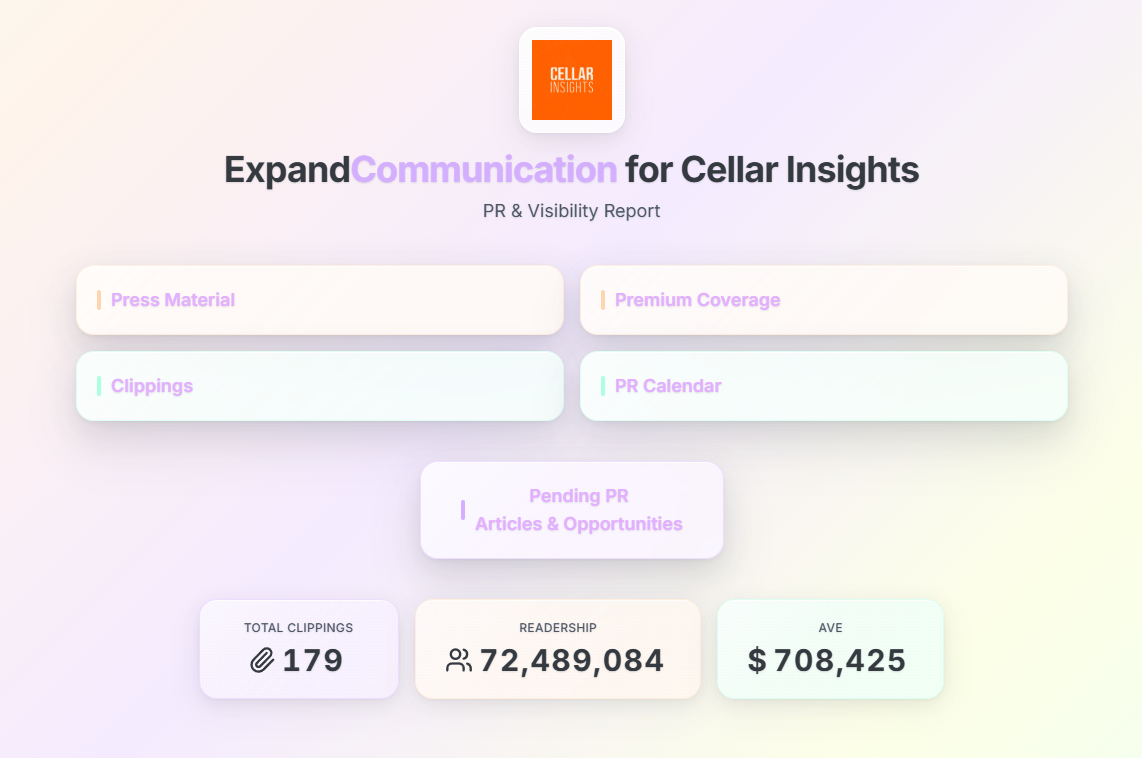
Source: ExpandCommunication PR & Visibility Report for Cellar Insights, August 2026.
Together, that creates a practical publish-measure-iterate loop:
- Diagnose the current representation.
- Establish governed facts and priority messages.
- Publish and amplify the right evidence.
- Measure changes across the prompts and platforms that matter.
- Correct gaps as the market and AI results evolve.
A practical 90-day starting plan
Days 1–30: Audit the visibility gap
- Test priority category, comparison, shortlist, and problem-based prompts across relevant AI platforms.
- Inventory recent earned media, press releases, authoritative third-party mentions, and owned resources.
- Identify missing facts, outdated narratives, source weaknesses, and competitor advantages.
- Align priority messages with the ICP, buyer journey, and current growth goals.
Days 31–60: Build and publish correction assets
- Refresh company boilerplate, priority web pages, and governed facts.
- Create fact-based communications tied to real milestones and buyer needs.
- Brief executives on evidence-backed, quotable themes.
- Pitch relevant trade and business outlets with commercially useful angles.
- Coordinate owned, partner, and earned distribution.
Days 61–90: Measure and iterate
- Re-run the priority prompt set across the same platforms and conditions.
- Track changes in brand inclusion, description accuracy, citations, competitor position, referral traffic, and influenced pipeline.
- Refresh source material as facts evolve.
- Invest further in the sources and formats associated with better representation.
The bottom line
PR can no longer be measured only by coverage volume, reach, or brand awareness. It is also part of the public evidence web-connected AI systems use when answering questions about markets, vendors, and emerging developments.
The opportunity is not to publish more announcements. It is to create a consistent body of current, verifiable information across owned content, credible third-party sources, industry coverage, and partner channels — and then measure whether that information changes how your company appears in the buying questions that matter.
GridStrat helps founder-led B2B teams identify those representation gaps and turn them into a focused 90-day correction plan.
Start with a Diagnostic Sprint
See which sources are shaping how AI systems represent your company when buyers ask the questions that matter — and turn the gaps into a prioritized 90-day correction plan. If you are a founder, CEO, VP Marketing, or Head of Growth at a B2B technology company, start with a structured baseline.
Request an AI Visibility Diagnostic